
Defenses for Spring 2026
Plume-scale new particle formation during the Houston TRACER-MAP campaign
July 20, 2026
Hannah Grace Marti
New particle formation (NPF), the creation of atmospheric particles from gas-phase precursors, is responsible for about half of the particles at climate-relevant sizes in the lower troposphere, giving this process significant climate impact through the direct and indirect aerosol radiative effects. NPF has long been studied from the stationary perspective, potentially neglecting the impact of…
Modeling Fine Particulate Matter and Quantifying Source Contributions in Central America
July 07, 2026
Ana Elizabeth Lasso de la Vega Guerra
Fine particulate matter (PM2.5) poses a significant public health burden across Central America, yet the region remains critically undermonitored and largely absent from source-resolved air quality assessments. Ground-based monitoring networks are sparse, and satellite-based retrievals are limited by persistent cloud cover and high humidity, reducing the reliability of either observational…
Mobile measurements of ozone, its precursors, and air toxics at the local and regional scale during the Colorado Front Range OZone Éxperiment (FROZÉ 2025)
July 02, 2026
Jared Stickney
The Colorado Denver Metro/North Front Range (DMNFR) area has been designated as nonattainment for ozone (O3) by the Environmental Protection Agency, as this region frequently exceeds the National Ambient Air Quality Standard (NAAQS) for O3 in the summer. Despite significant reductions in emissions of precursor nitrogen oxides (NOx = NO + NO2) and volatile organic compounds (VOCs) in recent…
Towards Goes Retrievals of Near-Cloud Aerosols: Machine Learning Development and Assessment of Radiative Effects
June 29, 2026
Olivia Pierpaoli
Atmospheric aerosols play a central role in Earth’s radiation budget and hydrological cycle, yet they remain a major source of uncertainty in estimates of anthropogenic climate forcing. Passive satellite observations have become a primary means of monitoring and characterizing aerosols. However, their applicability is limited in near-cloud regions. Current operational retrieval methods…
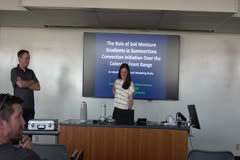
The Role of Soil Moisture Gradients in Summertime Convection Initiation over the Colorado Front Range: An Idealized Numerical Modeling Study
June 22, 2026
Evan Cowden
And here is my abstract: This study investigates how horizontal soil moisture gradients influence the initiation of convection (CI) along the Colorado Front Range using idealized convection-permitting simulations with the Weather Research and Forecasting (WRF) model. Using the tornado outbreak event of 21–22 June 2023 as a case study, eight perturbation experiments were conducted where the…
From Megacities to Wildfire Smoke: Observational Constraints on Atmospheric Ammonia
March 25, 2026
Emily Lill
Urban ammonia (NH3) emissions are an increasingly important component of atmospheric nitrogen cycling and fine particulate matter (PM2.5) formation, yet they remain poorly constrained in both observations and models. While agricultural sources have historically dominated NH3 budgets, emerging evidence suggests that mobile sources and urban activities may play a larger role than currently…
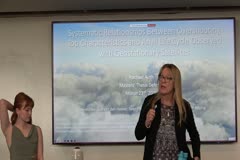
Systematic Relationships Between Overshooting Top Characteristics and Anvil Life Cycle Observed with Geostationary Satellites
March 23, 2026
Rachael Auth
Deep convective storms with strong updrafts generate robust anvils and distinct cloud top structures. These structures, including overshooting tops (OTs) and above-anvil cirrus plumes (AACP), can be routinely identified atop the most powerful storms on the planet, and are often indicative of severe weather, including tornadoes and large hail. The overarching goal of this study is to assess how…

Revisiting the Importance of a Southern Ocean Pattern Effect
February 25, 2026
Killian McSweeney
The spatial pattern of surface warming determines radiative feedbacks (“pattern effect”). The seminal work of Senior & Mitchell (2000) (SM00) argued that Southern Ocean clouds set the evolution of global radiative feedbacks in time and hence, determine climate sensitivity. We revisit their argument in current generation climate models: We quantify the time evolution of local atmospheric…

Contextualizing Past and Future Mean Southwest U.S. Precipitation with Marine Heatwaves
February 04, 2026
Olivia Lee
As the Southwest U.S. (SWUS) grapples with continued drought and increased water scarcity, paleoclimate analyses suggest the SWUS was wetter during past warm climates such as the Pliocene. One hypothesis for a wetter SWUS in the Pliocene is that warmer eastern Pacific sea surface temperature (SST) during the Pliocene enhanced North American Monsoon precipitation. Similarly, warmer California…