
Defenses for Fall 2025
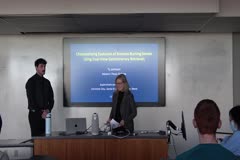
Characterizing Evolution of Biomass Burning Smoke Using Dual-View Geostationary Satellite Retrievals
December 15, 2025
Ty Johnson
Biomass burning has long been recognized as a key source of global aerosol and greenhouse gas emissions. Emissions from biomass burning have significant impacts on air quality, human health, and radiative budgets. In recent years, increases in the frequency and severity of wildfires have drawn more attention to the need for improved characterization of smoke and the complex processes which…

Tracking Reactive Nitrogen Plumes and Their Evolution from Satellite Observations
November 11, 2025
Madison Shogrin
Satellite remote sensing offers near-continuous global coverage and plays a critical role in addressing observational gaps for many atmospheric trace gases. Reactive nitrogen species are critical in atmospheric chemistry because they drive tropospheric ozone (O3) formation and contribute to the production of secondary aerosols. This dissertation presents novel satellite-based observations and…
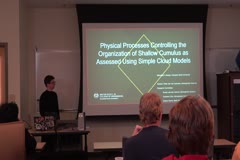
Physical Processes Controlling the Organization of Shallow Cumulus as Assessed Using Simple Cloud Models
October 30, 2025
Michelle Kanipe
Shallow cumulus are ubiquitous throughout the maritime tropics and commonly self-organize into distinguishable patterns. These patterns have widely varied radiative effects and thus induce a large source of uncertainty in climate modeling. Four such patterns have gained particular attention in the past decade as identified in a study by Stevens et al (2019); these patterns are colloquially…
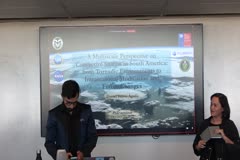
A Multiscale Perspective on Convective Storms in South America: From Tornadic Environments to Intraseasonal Modulation and Future Changes
October 29, 2025
Daniel Veloso
Convective storms are a key component of the Earth’s climate system, producing a significant fraction of global precipitation, and are often associated with severe weather, including flash floods, large hail, and strong winds. While convection is a global phenomenon, its nature is strongly modulated by geographical characteristics. South America is a natural laboratory for studying a wide…
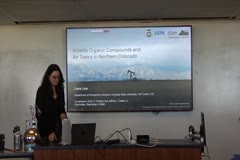
Volatile Organic Compounds and Air Toxics in Northern Colorado
October 09, 2025
Lena Low
The Colorado Northern Front Range (CNFR), stretching from Denver to Fort Collins, has significant air pollution challenges. Regional pollution sources include volatile organic compounds (VOCs) from urban activities, oil and gas (O&G) exploration and production, biogenic emissions, and wildfire smoke. The CNFR has been repeatedly designated as a nonattainment area for ozone, making reductions…

Summertime spatiotemporal patterns of nitrogen oxides (NOx) in Salt Lake City
October 03, 2025
Daniela Guevara
Salt Lake City, UT experiences persistent summertime ozone (O3) exceedances of the National Ambient Air Quality Standard (NAAQS). During the 2024 Salt Lake City-Summer Ozone Study (SLC-SOS), we deployed the Aerodyne dual channel Cavity Attenuated Phase Shift Monitor (CAPS) in a mobile laboratory to quantify regional gradients and daily variability of nitrogen oxides (NOx). Our analysis for…

Investigating the Sources of Southern Ocean and Coastal Antarctic Ice Nucleating Particles: The Cloud and Aerosol Impacts over the Southern Ocean (CAISO) Project
September 22, 2025
Chelsea Bekemeier
The Southern Ocean is the cloudiest region on Earth, where low-level mixed-phase clouds are a critical control on climate feedbacks. The liquid or ice content within these clouds controls their reflectivity, thus modulating shortwave radiation reaching the surface. Climate models struggle to accurately simulate absorbed shortwave radiation over the Southern Ocean due to limitations in…
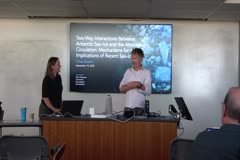
Two-Way Interactions Between Antarctic Sea Ice and the Atmospheric Circulation: Mechanisms for and Implications of Recent Sea-Ice Loss
September 10, 2025
Chloe Boehm
In contrast to the Arctic, Antarctic sea ice has experienced both long-term positive and negative trends across the observational record. From the 1980s until 2015, Antarctic sea ice experienced a slight positive trend, while Arctic sea ice experienced a consistent negative trend. These weak but steady increases ended abruptly during the austral summer of 2015, when Antarctic sea-ice extent…
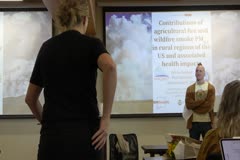
Contribution of Agricultural Fire and Wildfire Smoke to PM2.5 Concentrations in Rural Regions of the US and the Associated Health Impacts
September 09, 2025
Olivia Sablan
Exposure to landscape fire smoke is a growing public health concern. Fine particulate matter (PM2.5) from fires has been associated with a suite of adverse cardiorespiratory health outcomes, yet many rural and underserved regions lack adequate monitoring to quantify smoke PM2.5 to then determine health impacts. We quantified smoke PM2.5 from wildfires in New Mexico and agricultural fires in…
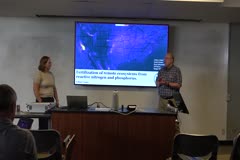
From Source to Receptor, Unpacking Emissions and Deposition of Reactive Nitrogen
September 08, 2025
Lilly Naimie
Deposition of excess nutrients can have negative impacts on ecosystem health. This work will focus on frontiers in reactive nitrogen (Nr) deposition and emissions. Nr deposition in the US has experienced a regime shift, due to effective nitrous oxide (NOx) emissions regulations, and is now dominated by reduced N (gaseous ammonia (NH3) and particulate ammonium (NH4+)). Nr deposition is of…
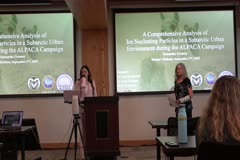
A Comprehensive Analysis of Ice Nucleating Particles in a Subarctic Urban Environment during the ALPACA Campaign
September 03, 2025
Samantha Greeney
Ice nucleating particles (INPs) influence cloud properties, precipitation, and radiative forcing, yet their sources and characteristics remain poorly understood, especially in polluted Arctic and subarctic environments. This study investigates the size and composition of immersion-mode INPs during the Alaskan Layered Pollution And Chemical Analysis (ALPACA) field campaign, conducted in…
Towards a Physically Informed Understanding of New Particle Formation and Growth in the Atmosphere
August 29, 2025
Samuel O’Donnell
Aerosol particles are among the most uncertain yet influential components of Earth’s radiative balance, influencing it directly through interactions with radiation and indirectly by serving as the formation sites for cloud droplets and ice crystals. Understanding the size and composition of the aerosol particles is critical for understanding their climate impacts. The majority of aerosol…
Evaluating the Frequency, Size, and Duration of Dust Storms in the United States using Satellite and Surface Data
August 19, 2025
Jennifer McGinnis
The United States (US) experiences frequent dust storms that are primarily identified using ground-based monitoring networks. However, current ground monitor networks are unable to capture the full extent of dust exposure due to limited spatial coverage. Leveraging satellite data can help bridge these gaps in surface in situ data. Using the GOES-East geostationary satellite and a longwave-based…
3D CLOUD NOWCASTING: MERGING EXTRAPOLATION WITH MACHINE LEARNING
August 13, 2025
Matt King
Short-term prediction of clouds (0-3 hours), or cloud nowcasting, is critical for both civilian and military operations, ranging from solar energy management to intelligence gathering. Despite the capabilities of contemporary numerical weather prediction (NWP) models, nowcasting methods based on near real-time observations (i.e. satellite imagery) hold operational value due to their relative…
Decoding Deep Convection: Linking Cloud Top Cooling to Environmental Conditions and Storm Evolution
August 12, 2025
Tom Juliano
Forecasting severe deep convection (DC) remains a critical challenge in atmospheric science, particularly during the early stages of storm development when traditional radar-based methods may lack sensitivity. This study explores the use of optical flow-based cloud-top cooling (CTC) as a diagnostic tool for identifying and characterizing DC initiation, environments, and subsequent evolution. By…
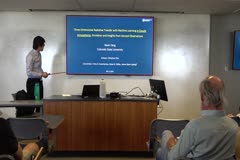
THREE-DIMENSIONAL RADIATIVE TRANSFER WITH MACHINE LEARNING: EMULATION AND INSIGHTS FROM AEROSOL OBSERVATIONS
August 11, 2025
Kevin Yang
Radiation plays a central role in the Earth system, governing the distribution of energy and driving key processes in weather and climate. Atmospheric radiative transfer (RT), which describes the physical processes governing the propagation and interaction of radiation in the atmosphere, can be modeled with high accuracy using sophisticated mathematical formulations under well-defined…
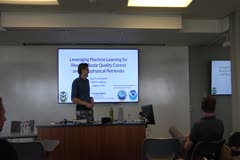
Leveraging Machine Learning for Weather Radar Quality Control and Microphysical Retrievals
August 05, 2025
Isaac Schluesche
Data from meteorological radars must undergo an extensive quality control process in order to become useful. A primary part of the process is the removal of measurements returned by non-meteorological features such as the earth’s surface and biological targets (birds, insects, etc.). Existing methods struggle to achieve acceptable levels of non-meteorological data (NMD) removal in a timely…